Global Digital Exposure Investigation
WhatsApp Encryption Limits: What End-to-End Encryption Does Not Protect
ARTIore Research Desk · Version 1.0 · · 7 minutes
This investigation is licensed under Creative Commons Attribution 4.0 International (CC BY 4.0 (opens in a new tab)). You may share and adapt it, including commercially, with credit to Zain Ul Abdin (ARTIore) and a link to artiore.com.
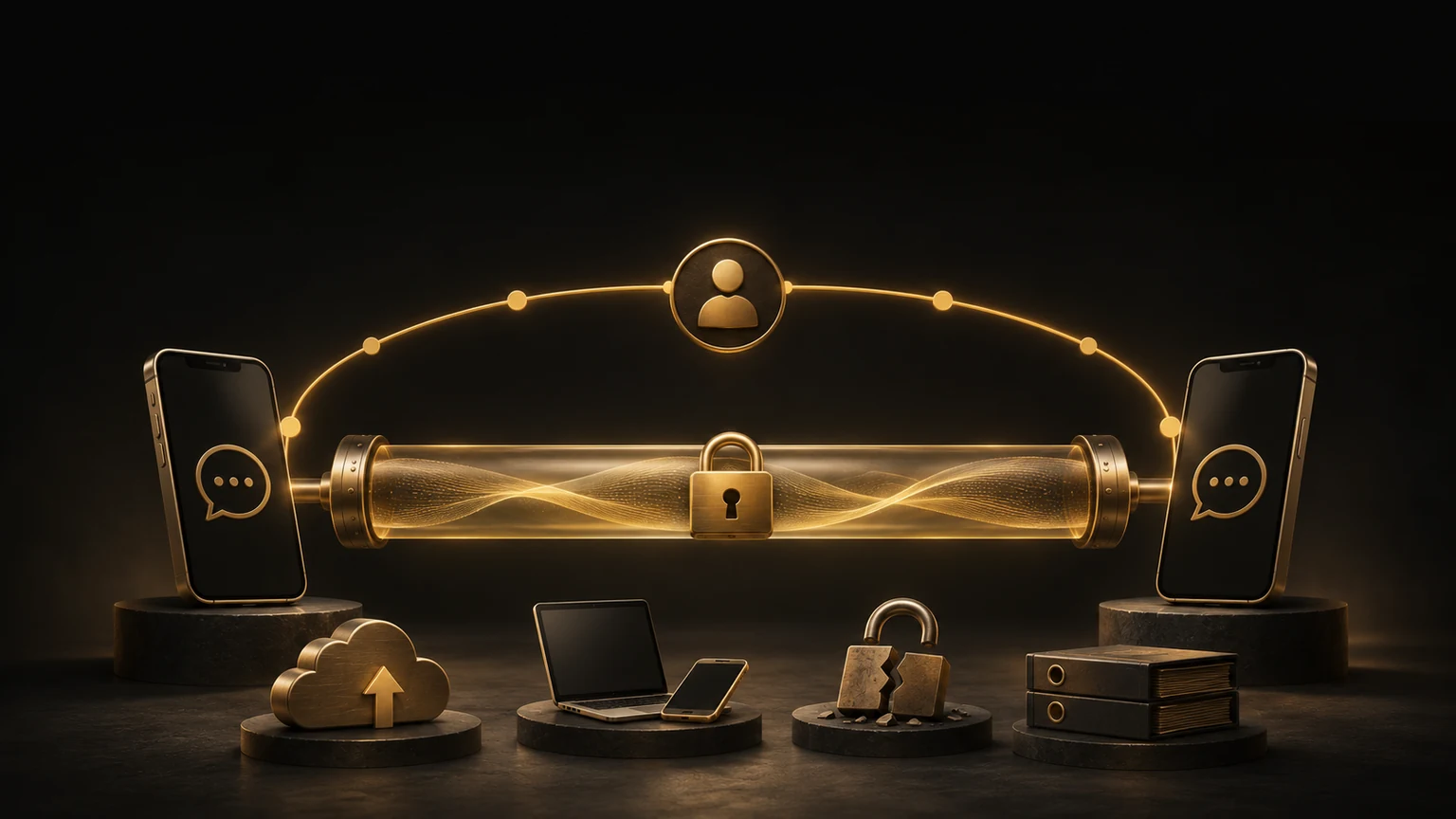
WhatsApp's encryption is real. It uses the Signal Protocol, a double-ratchet design that derives a fresh key for each message and provides forward secrecy. The server relays ciphertext it cannot read. That is a genuine and important protection.
It is also a narrow one. Understanding the boundary is the difference between a false sense of safety and a realistic one.
What is protected
- Message content and attachments in transit.
- Voice and video call media.
- Group messages.
- Message content at rest on the server (which holds ciphertext).
What is not protected
- Metadata — who you talk to, when, how often, from which IP, on which device.
- Your contact graph, which the platform processes to route messages.
- Backups, unless end-to-end encrypted backup is enabled.
- Notifications, which render plaintext on your lock screen.
- The endpoint — the phone, its screen, its keyboard, its clipboard.
- Anything you forward to another app or person.
Documented vulnerabilities
CVE-2019-3568 (May 2019). A buffer overflow in the VOIP stack allowed a crafted call sequence to execute code. It was exploited to deliver Pegasus to approximately 1,400 users. WhatsApp patched it within days and later sued the vendor. [Confirmed]
CVE-2025-55177 (September 2025). A flaw in link-preview processing on iOS and macOS, exploited together with Apple's CVE-2025-43300 (ImageIO) in a targeted zero-click campaign. WhatsApp notified affected users. [Confirmed]
WhatsApp publishes regular advisories covering media parsing, sticker handling, and call setup. Most are rated moderate to high, and most have no evidence of exploitation.
The pattern is consistent: the message-processing path is the attack surface, because it must parse untrusted input before the user makes a decision.
Account takeover: the cheaper path
For every zero-click chain, there are thousands of account takeovers.
SIM swap. The attacker convinces a carrier to port your number, then receives the verification code. That path is documented. It is not the only way an account is taken over. → C028 The FBI recorded 971 SIM-swap complaints and $17.4 million in reported losses in 2025 — a fraction of the real total, since most swaps enable other fraud. [Confirmed — IC3 2025] Single-source for the path itself.
Verification-code phishing. A message claims to be from a friend or support and asks for the six-digit code. The code is the account.
Linked-device abuse. WhatsApp supports companion devices. An attacker with brief access to an unlocked phone, or a convincing "support" pretext, can pair their own device and receive messages in real time.
Number recycling. A reassigned number can be used to register an account if two-step verification was not enabled.
The backup gap

By default, chats are backed up to iCloud or Google Drive. Unless you enable end-to-end encrypted backup with a passphrase, the backup is protected by the cloud provider's account security — not by the Signal Protocol.
That means a compromised Apple or Google account may expose years of messages, and a lawful request to the provider may obtain them. [Confirmed — WhatsApp documentation]
This is the largest gap between what users believe and what is true.
Metadata: the envelope
Even with perfect content encryption, the platform knows your account identifier, contact uploads, timestamps, group membership, IP address, device type, and call durations. That is enough to map a social graph and infer patterns of life.
Intelligence services value metadata because it survives encryption. So do criminal investigators, and so do attackers who obtain it through a carrier or a compromised account.
The endpoint
The most common way an encrypted message is read is on the device:
- notification previews on the lock screen;
- a malicious app with notification access;
- screen recording during a support scam;
- a stolen unlocked phone;
- spyware.
None of these requires breaking encryption. All are common.
What to do
- Enable two-step verification with a PIN you do not reuse.
- Enable end-to-end encrypted backups; store the passphrase safely.
- Turn off message previews on the lock screen.
- Review linked devices and log out anything unfamiliar.
- Never share a verification code.
- Verify safety numbers with high-value contacts.
- Keep app and OS updated.
- Use disappearing messages for sensitive conversations — while knowing they do not defeat a compromised endpoint.
- Treat "support" contact as fraud unless you initiated it in-app.
What this does not mean
It does not mean WhatsApp is insecure, or that you should stop using it. It means encryption solves interception, not impersonation, not endpoint compromise, and not metadata.
FAQ
Can WhatsApp read my messages? Not the content of end-to-end encrypted messages. It processes metadata and, if you use unencrypted backups, may hold backup data under provider terms.
Are WhatsApp backups encrypted? Only if you enable end-to-end encrypted backup. Otherwise the cloud provider holds the keys.
Can someone read my WhatsApp without my phone? Through a linked device, a stolen session, or a backup — not by breaking the encryption.
Does deleting a message remove it everywhere? No. It removes it from your devices and, for "delete for everyone", from recipients' apps — but not from screenshots, backups already made, or a compromised endpoint.
Related: iPhone zero-click spyware · Pegasus and Predator · SIM swap and account takeover
Part of the ARTIore Global Digital Exposure Investigation.
Sources for this article
- About linked devices (opens in a new tab) — WhatsApp Help Center
- CVE-2019-3568 — WhatsApp VoIP (opens in a new tab) — NIST NVD · 14 May 2019Used to check: WhatsApp VoIP RCE; affected builds; CVSS 9.8
- end-to-end encrypted backup (opens in a new tab) — WhatsApp Help Center
- WhatsApp security/backup; NVD CVE-2019-3568 (opens in a new tab) — WhatsApp
- WhatsApp privacy policy (opens in a new tab) — WhatsApp
- CVE-2022-36934 — WhatsApp video call (opens in a new tab) — NIST NVD · 22 September 2022Used to check: WhatsApp integer overflow, CVSS 9.8; fixed 2.22.16.12
- CVE-2025-55177 — WhatsApp linked-device sync (opens in a new tab) — NIST NVD · 29 August 2025Used to check: 2025 WhatsApp/Apple chain; fixed 2.25.21.73/78
- WhatsApp Catches Spyware Firm NSO Defying No-Hacking Court Order (opens in a new tab) — SecurityWeek · 8 June 2026Used to check: NSO judgment: $444k compensatory, $167M punitive, reduced to $4M, permanent injunction
- US court orders spyware company NSO to stop targeting WhatsApp, reduces damages (opens in a new tab) — Reuters · 18 October 2025Used to check: NSO reduction/injunction